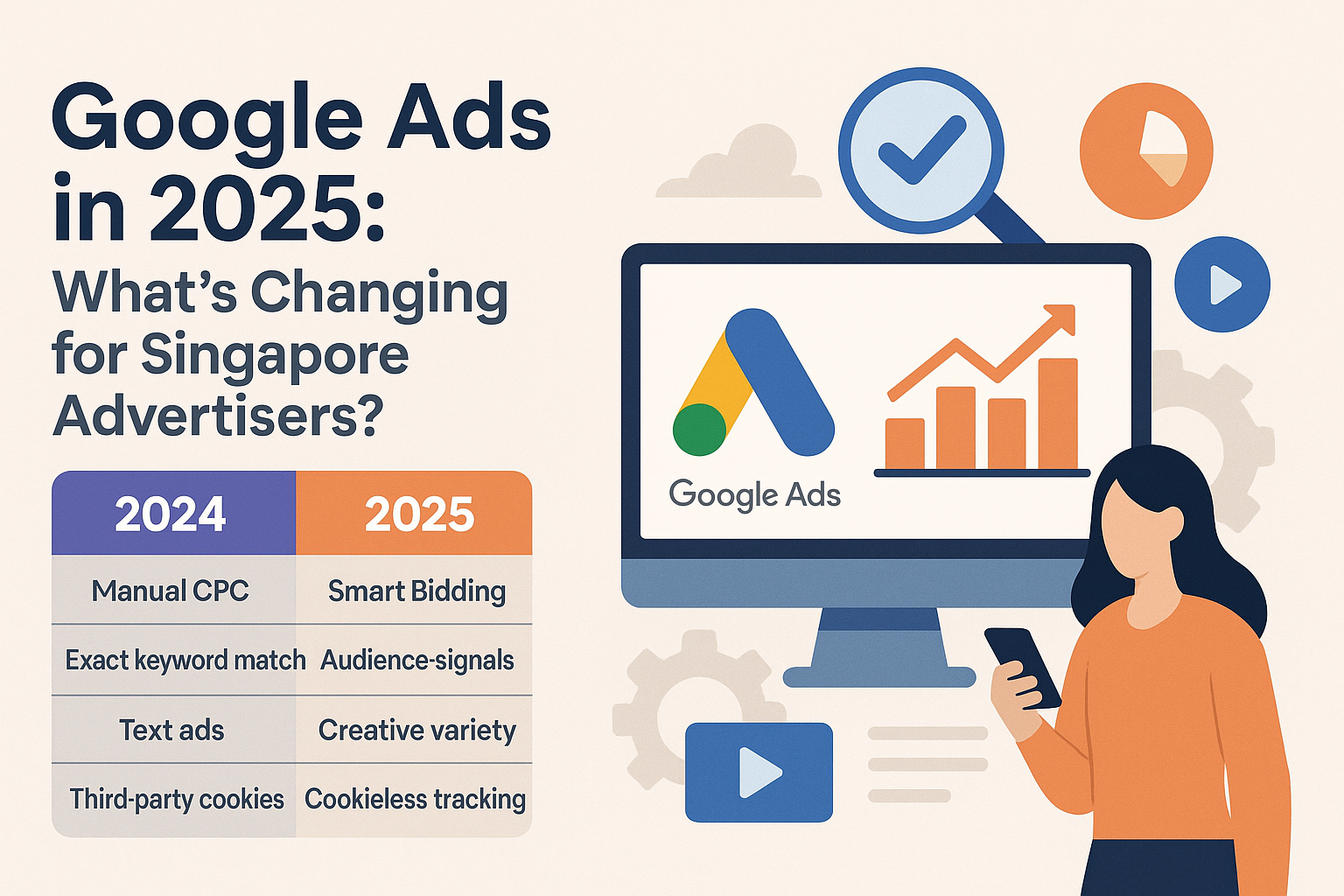
Introduction: Navigating the New Google Ads Landscape
With rising CPCs, stricter privacy regulations, and rapid automation, Google Ads trends Singapore 2025 show that advertisers are facing more complexity than ever before. Many business owners are now asking: What exactly is changing? And more importantly, how do these changes affect results, budgets, and strategy?
This comparison-style breakdown of Google Ads trends Singapore 2025 highlights the biggest differences between how Google Ads worked before and what advertisers must prepare for in 2025.
Google Ads 2024 vs Google Ads 2025: What’s Different?
1. Automation: Optional Before, Mandatory Now
2024: Advertisers could choose between manual CPC, enhanced CPC, or partial automation.
2025: Full automation is now the default. Manual bidding is almost gone.
| Feature | 2024 | 2025 |
|---|---|---|
| Manual CPC | Available | Deprecated |
| Smart Bidding | Recommended | Required |
| Control level | High | Lower |
| Learning period | Short | Longer but more accurate |
For a deeper look at how automation impacts broader digital campaigns, explore the insights in Digital Campaigns That Convert.
2. Search Intent Targeting: Keyword-Heavy vs AI-Heavy
2024: Success depended heavily on keyword structure (SKAGs, exact match targeting, long-tail clusters).
2025: Google Ads now leans on intent signals, user behaviour, and semantic understanding over exact keywords.
| Factor | 2024 Priority | 2025 Priority |
|---|---|---|
| Exact keyword match | Very high | Medium |
| Audience signals | Medium | Very high |
| Creative quality | Medium | High |
| First-party data | Nice to have | Mandatory |
This shift means advertisers must align search intent with strong content. For that,you can take a look at Strategic SEO Content Writing
3. Creative Requirements: Static Ads vs Multi-Asset Performance
2024: A few text ads and simple visuals were enough.
2025: Google rewards advertisers who supply creative variety: video, lifestyle visuals, product feeds, and multi-format assets.
| Creative Type | 2024 | 2025 |
|---|---|---|
| Text Only | Common | Underperforms |
| Responsive Search Ads | Recommended | Required |
| Video Assets | Optional | Strongly recommended |
| Lifestyle & UGC | Rare | High impact |
Singapore brands now need more intentional creative pipelines to stay competitive.
4. Performance Max: Add-On vs Must-Have
2024: PMax was treated as an advanced or experimental campaign.
2025: It is now the default campaign for e-commerce, B2C, and even lead gen businesses.
Pros in 2025:
- Stronger cross-channel reach
- Better AI modelling
- Higher conversions
Cons in 2025:
- Less transparency
- Harder to control placements
- Requires significant first-party data
For advertisers interested in how integrated campaigns affect lead generation, please take a look at Brand Marketing Singapore Success
5. Privacy Shifts: Third-Party Cookies vs Cookieless Tracking
2024: Cookies still played a major role in remarketing.
2025: Google Chrome’s cookie phaseout is nearly complete.
What this means for Singapore advertisers:
- Audience lists shrink
- Lookalike models weaken
- Tracking depends heavily on GA4 + server-side tagging
- CRM integrations become essential
Businesses that adapt early will see stronger ROAS despite the transition.
Which Approach Works Best in 2025?
Best For Lead Generation:
2025 Strategy Wins: AI-driven bidding + strong landing pages + first-party audience signals.
Best For E-Commerce:
2025 Strategy Wins: Performance Max + product feeds + creative diversity.
Best For B2B:
Hybrid Approach: Keyword structure still matters, but intent modelling and quality content now carry more weight.
Conclusion
Success with Google Ads in 2025 is no longer about perfect keyword lists, it’s about signals, automation, and creative depth. Singapore advertisers who embrace AI-driven optimisation and invest in high-quality content, first-party data, and conversion-focused web design will outperform the competition.
If you want to adapt your campaigns to these new Google Ads trends Singapore 2025, contact GOSG Consulting and let’s build a performance strategy that stays ahead of every update.
Leave a Reply